


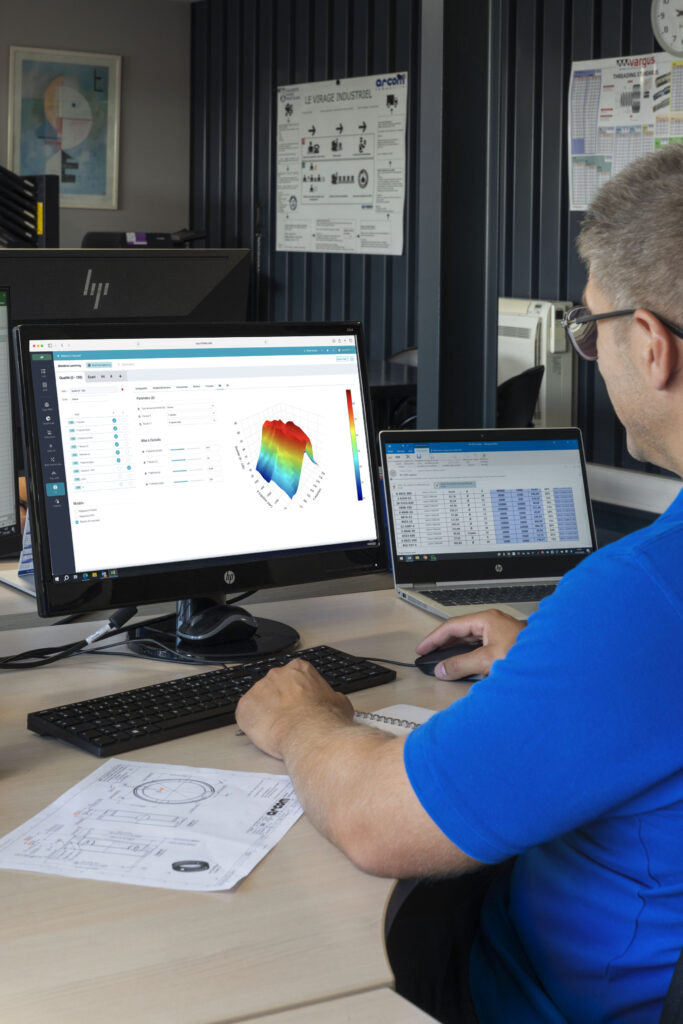
Ellistat is enhancing DATA Analysis with AI to improve control over industrial processes
As an expert in industrial quality, Ellistat is enhancing its DATA Analysis module with new artificial intelligence capabilities. In addition to machine learning and classification, the integration of neural networks makes it possible to model more complex industrial behaviors. With this software update, Ellistat is opting for an applied, gradual, and controlled approach to AI.
Understanding the causes of discrepancies and taking action on the right metrics is no longer just an intention—it is now a concrete approach.
Useful AI, not just an abstract promise
For Ellistat, artificial intelligence is only valuable if it actually helps manufacturers
to produce better results. And to do that, it must first be accessible to everyone. Quality depends on
based on a simple principle: mastering one's processes, that is, understanding the parameters
factors that affect production—temperature, tool, material, machine, operator,
supplier, configuration, environment. But identifying these factors usually requires
statistical skills that not everyone has, and that few workshops
have time to mobilize.
When a deviation, discrepancy, or variation occurs, identifying the cause often involves
about the investigation: we proceed based on intuition, testing one parameter after another, and time
Time spent searching results in waste, delays, and adjustments that are more like
experience rather than evidence.
That's where DATA Analysis comes in: the software handles the complex part—the
calculations, models, and statistical methods—and presents it through an interface
Simple. You don't need to be a data science expert to analyze your data and identify the
influential variables, understanding the causes of variations, and building models
that can be used in the field. This gives everyone access to analytical capabilities that were previously
intended for specialists only.
This accessibility also defines the software's target audience. DATA Analysis is not limited to
experts in statistics or artificial intelligence: it is primarily intended for those who
are familiar with the process—process engineers, production engineers, and quality engineers. They are the ones who
have the on-the-ground knowledge, and it is for them that the tool must provide the analysis
accessible.
The new AI features follow this logic exactly: they add
power without sacrificing ease of use. For a non-expert user,
The approach remains guided, step by step. For an expert profile, the software offers more options
in-depth, with advanced settings for model structure and functions
activation: the user can configure a neural network, choose a training mode,
adjust how the model learns from the data or add neurons
depending on the desired level of analysis. The same interface thus adapts to the level of
each one, from rapid diagnosis to detailed modeling.
«Industrial AI shouldn't be just another black box on the factory floor. It should help the
teams to understand what's really happening in their processes. With DATA
Analysis: We want to provide manufacturers with more powerful models, but
useful to those who know the field. That's how AI becomes useful:
»when it informs production decisions," explains Davy Pillet, CEO of Ellistat.
From Classical Statistics to AI Models
The strength of DATA Analysis lies in the wide range of methods it brings together in a single tool. At the
Generally speaking, traditional statistics answer the most common questions in the workshop:
compare two variables, test whether a change has a real effect, measure a correlation,
build a regression model or a design of experiments. Easy to implement, these
These methods remain essential and form the foundation of a quality approach
rigorous.
The new version significantly expands this range. DATA Analysis includes
now includes machine learning models, neural networks, and
unsupervised classification. Whereas classical statistics describe simple relationships
Using a few variables, these models address phenomena in which many
The parameters interact: they determine the function that links the production conditions to the
the results obtained, and reveal patterns or behaviors that the eye
Humans don't distinguish between them.
This gives users a comprehensive range of options: they can choose the level of analysis that best suits
his question—from the two-variable test to the predictive model—without ever straying from the same
environment. The goal remains the same at every level: to reduce analysis time,
improve the reliability of diagnoses and focus efforts on the right levers.
At the Heart of the Ellistat Quality Suite
DATA Analysis is part of the Ellistat Quality Suite, a fully web-based software suite dedicated to
industrial-grade quality. The module truly shines when it leverages data from
other software components: using SPC to track the statistical trends of their
processes and monitor production in real time and perform incoming quality control (IQC) to compare suppliers,
analyze the quality of incoming shipments or track changes in supplier performance
back then.
This complementarity ensures consistency across the entire Quality Suite: collecting
collect data, monitor it, analyze it, and then make decisions based on facts.
Progressive and Controlled Industrial AI
With this evolution of DATA Analysis, Ellistat advocates a pragmatic approach to
artificial intelligence. No promises of autonomous factories. No out-of-touch rhetoric
production realities. AI must be based on reliable data and processes
clear and measurable objectives.
Ellistat has chosen an AI solution that helps manufacturers better analyze, better understand, and
better manage their processes.