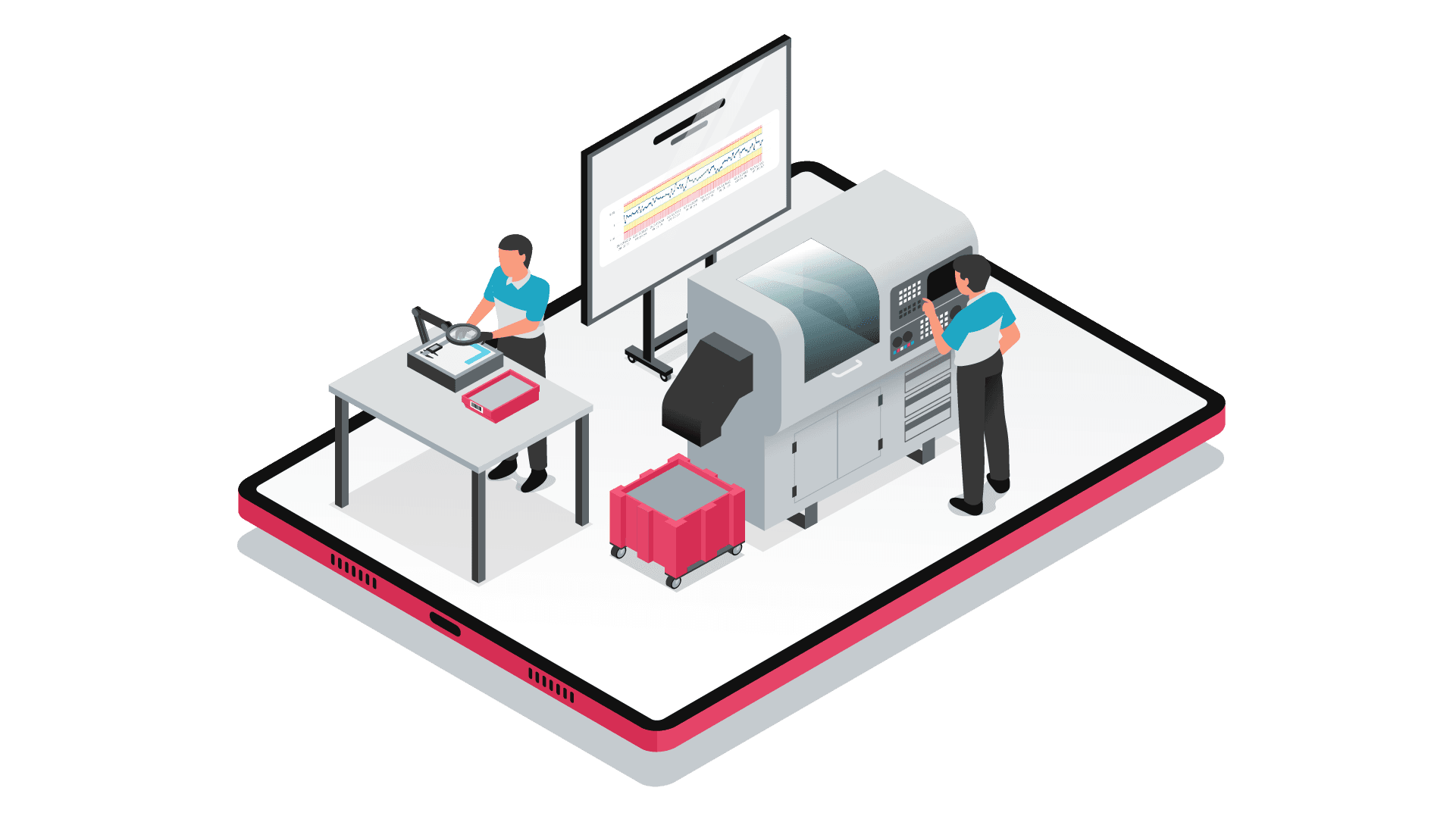
Statistical process control (SPC) is a must-have in precision engineering workshops. However, choosing the right SPC software remains a difficult exercise: the range of products on offer is heterogeneous, the sales pitches are all the same, and the features that really make a difference on a day-to-day basis are not always obvious from a product sheet.
This article offers a structured comparison of the main types of SPC solutions available in France, with the concrete criteria that count for a quality or production manager in mechanical engineering.
What SPC software really needs to do in the mechanical engineering industry
Before comparing tools, we need to agree on requirements. SPC software isn't just about plotting control charts. In a precision workshop, it must :
- Collect measurement data in real time, ideally directly from instruments (connected calipers, measuring columns, CMMs, etc.)
- Calculate and display capability indicators Cp, Cpk, Pp, Ppk, with clear interpretation
- Alert as soon as a drift is detected, before non-conforming parts accumulate
- Keep history for audits and traceability
- Can be used by operators, not just by quality engineers
These criteria seem obvious. However, not all SPC software on the market meets them with the same degree of efficiency.
The main categories of SPC software on the French market
General-purpose spreadsheet solutions
Some quality teams still use Excel as the basis for their SPC, with more or less elaborate templates. It's free, but there are many limitations: no automatic feed, no management of Nelson/Western Electric rules, no real-time alerts, time-consuming file maintenance. As soon as a workshop exceeds a few tracked references, the approach becomes unmanageable.
SPC modules integrated into ERP / MES systems
Some MES or industrial ERP software publishers offer a quality module including SPC functions. The advantage is native integration with the rest of the information system. The disadvantage: these modules are often less in-depth in statistical terms, not very flexible in terms of control chart configuration, and rarely designed by specialists in statistical process control. For workshops where quality is a central issue, they quickly show their limitations.
Specialized SPC software
This is the most relevant category for demanding machine shops. These tools are specifically designed for statistical production monitoring. There are solutions on the market from different origins (American, German, French) with different positioning.
French players include solutions such as Quasar Solutions (interface for quality engineers and statistics specialists), Infodream (production/ MES-oriented interface), Minitab (for offline analysis), or even Ellistat SPC, developed in Haute-Savoie, with a strong methodological foundation derived from the work of the Professor Maurice Pillet.
Decisive criteria for comparing SPC software
1. Connectivity to instruments and machines
This is often the first point of friction. SPC software without automated collection forces operators to enter values by hand, with all the risks of error and delay that this entails. Systematically check :
- Which communication protocols are supported (RS-232, Bluetooth, Ethernet)?
- Is the software compatible with your instruments (Mitutoyo, Marposs, Renishaw, etc.)?
- Can it retrieve data directly from a CMM?
2. Statistical richness and compliance with standards
Not all solutions offer the same level of rigor. Points to check:
- Support for standard control boards (X̄-R, X̄-s, I-MR, np, p, c, u)
- Application of signal detection rules (Nelson rules, Western Electric rules)
- Capability calculations in accordance with current standards (ISO 22514, AIAG, etc.)
- Handling non-normal distributions
3. Ergonomics for production operators
An SPC tool that operators don't use, because it's too complex or difficult to read, is useless. The interface must be clear, the alerts visible, and it must be quick to learn how to use. This is a criterion that is often underestimated at the time of evaluation, and yet it determines the real return on investment.
4. Deployment and maintenance
Full-web solutions (accessible via a browser, with no installation required on a workstation-by-workstation basis) considerably simplify deployment and updates. Conversely, locally-installed software entails significant hidden IT maintenance costs, especially in SMEs without a dedicated IT department.
5. Scalability to other quality modules
The SPC is rarely the only need. Sooner or later, the workshop will also want to manage its instruments (calibrations, Gage R&R), its incoming inspection and its batch traceability. Choosing a modular suite avoids multiplying tools and duplicating data entry.
What distinguishes Ellistat SPC from other solutions
Ellistat SPC is designed for precision mechanics workshops, with a distinctive feature: it is part of a complete quality suite in which the SPC does not operate in a silo.
A few concrete points of difference:
A control loop that can go as far as automatic machine correction. Combining SPC and APC module (Automated Process Control), Ellistat not only detects drift, but automatically corrects the machine tool setting in real time. No other solution on the French market offers such an integrated closed loop.
Full-web architecture. No installation on workstations, accessible from any browser. Updates are transparent. A real operational advantage for SMEs.
A coherent modular suite. Ellistat SPC can be supplemented with IQC (incoming inspection), METRO (instrument management), ROUTINES or DATA ANALYSIS, all accessible from the same database.
A solid methodological foundation. The Ellistat suite was developed in conjunction with the work of Professor Maurice Pillet, a French reference in statistical process control and Six Sigma. The result is a statistical rigor uncommon in production tools.
Synthetic comparison table
| Criteria | Spreadsheet / Excel | ERP/MES module | Specialized SPC (generic) | Ellistat SPC |
|---|---|---|---|---|
| Automatic collection | ✗ | Partial | ✓ | ✓ |
| Statistical richness | Low | Limited | Good to very good | Very good |
| Operator ergonomics | Variable | Variable | Variable | Designed for prod |
| Web architecture | ✗ | Depends | Rare | ✓ |
| Machine tool integration | ✗ | Limited | X | ✓ |
| Automated APC loop | ✗ | ✗ | ✗ | ✓ |
| Modular scalability | ✗ | Limited | According to publisher | Full suite |
How do you frame your choice in practice?
Some questions to ask during a demonstration or a call for tenders:
- What is the actual implementation timeframe?, from signature to the first active control card in production?
- How is the ramp-up managed? when the number of references tracked increases?
- Who trains operators, and what is the content of this training course?
- How evolution requests are handled or bug reports?
- What is the total cost over 3 years?, including maintenance, additional licenses and support?
These questions often reveal major discrepancies between solutions that appear comparable on paper.
Conclusion: choosing SPC software means choosing a method as well as a tool
SPC software comparison is not just a list of features. What you choose is also a way of working, a level of integration with your production, and the ability to evolve your quality approach over time.
For a precision mechanics workshop that wants to go beyond simple statistical monitoring, and aim for real control of its processes, with less scrap and more autonomy, specialized and modular solutions have a structural advantage over generalist modules.
FAQ
What's the difference between SPC and APC? SPC (Statistical Process Control) monitors production and detects statistical drifts. APC (Automated Process Control) goes a step further: it automatically corrects machine settings as soon as a drift is identified. The two are complementary: SPC provides visibility, APC enables action.
Is SPC software mandatory to comply with IATF 16949? The IATF 16949 standard requires statistical process control for special features, but does not prescribe any particular tool. In practice, dedicated SPC software facilitates compliance and traceability during customer or certification audits.
How long does it take to deploy SPC software on the shop floor? This depends on the number of references monitored, the number of instruments and the desired level of connectivity. Pilot deployment on an island can be completed in a few weeks. Full implementation, including operator training, generally takes 1 to 3 months.
Can SPC software be used for small production runs? Yes, provided the tool is designed for it. Some solutions are calibrated for large-scale automotive production. Others, such as Ellistat, are equally well suited to small and medium-sized workshops with numerous part numbers, thanks in particular to their rapid configuration.
SaaS or On-Premise: which deployment method should you choose for your SPC software? SaaS simplifies maintenance and multi-site access. On-Premise is suitable for workshops with security or network connection constraints. Some publishers offer both options, so you can tailor your choice to your business context.