
Choosing an industrial-grade software suite often comes down to choosing between two bad options:
- outdated spreadsheets that don't communicate with each other,
- or powerful but siloed specialized tools, the use of which is limited to a handful of statistical experts.
Founded nine years ago, Ellistat was developed in direct response to this observation from the field, by creating an integrated suite designed for quality professionals, production managers, and Six Sigma Black Belts and Green Belts.
Nine years after its creation, it is time to provide a comprehensive overview of this industrial quality software suite: what it covers, how its modules work together, and the progress made from its initial development to the most recent modules.
An industrial-grade software suite born out of real-world experience
Ellistat was founded on a simple belief: statistical and quality tools should not be reserved for math experts. All too often, software on the market required weeks of training, expensive licenses, and advanced statistical expertise to derive value from it. The founders’ ambition (Davy PILLET and Maurice PILLET) was the opposite: to make rigorous methods (SPC, MSA, experimental designs, data analysis, etc.) accessible through a clear interface designed for everyday industrial use.
Over the years, the company has grown while remaining true to this philosophy: every feature developed addresses a real need. A need expressed by users on the factory floor. This close connection to the field largely explains the loyalty of its user base, which today ranges from industrial SMEs to major automotive, aerospace, and pharmaceutical companies.
Modules of the Ellistat Industrial Quality Software Suite
The strength of the suite lies in its modularity. Each module covers a step in the quality cycle—from production control to structured continuous improvement—and all modules communicate with one another.
1. Ellistat Data Analysis
The module Data Analysis is the first module developed by Ellistat. It’s the one that started it all, even before the quality suite took on its current form. It is designed for Six Sigma practitioners, process engineers, and anyone who needs to go beyond mere observation to identify the root causes of defects or optimize manufacturing parameters.
It includes a comprehensive set of advanced statistical tools: analysis of variance (ANOVA), linear and multiple regressions, parametric and nonparametric hypothesis tests, and, most importantly, Design of Experiments (DoE), with automatic generation of full, fractional, or response surface designs, and multi-response optimization. These features enable users to carry out rigorous improvement projects without the need for external statistical software.
The module really comes into its own when it is connected to the other modules in the suite. The data collected in production via the SPC, the APC or the IQC become immediately usable for in-depth analysis. Identify the source of a deviation, statistically differentiate between suppliers, and correlate process variables with one another. This shift moves us beyond simple production monitoring to a true understanding of causal relationships, leading to targeted and sustainable corrective actions.
2. Ellistat APC (Automated Process Control) — Set up your machine tools in a single setup
The module APC (Automated Process Control) is the second module developed by Ellistat, and arguably the most innovative in the suite. It fully automates the adjustment of machine tools using machine learning: during each measurement cycle, it analyzes deviations, calculates the necessary corrections, and sends them directly to the machine tool, without human intervention.
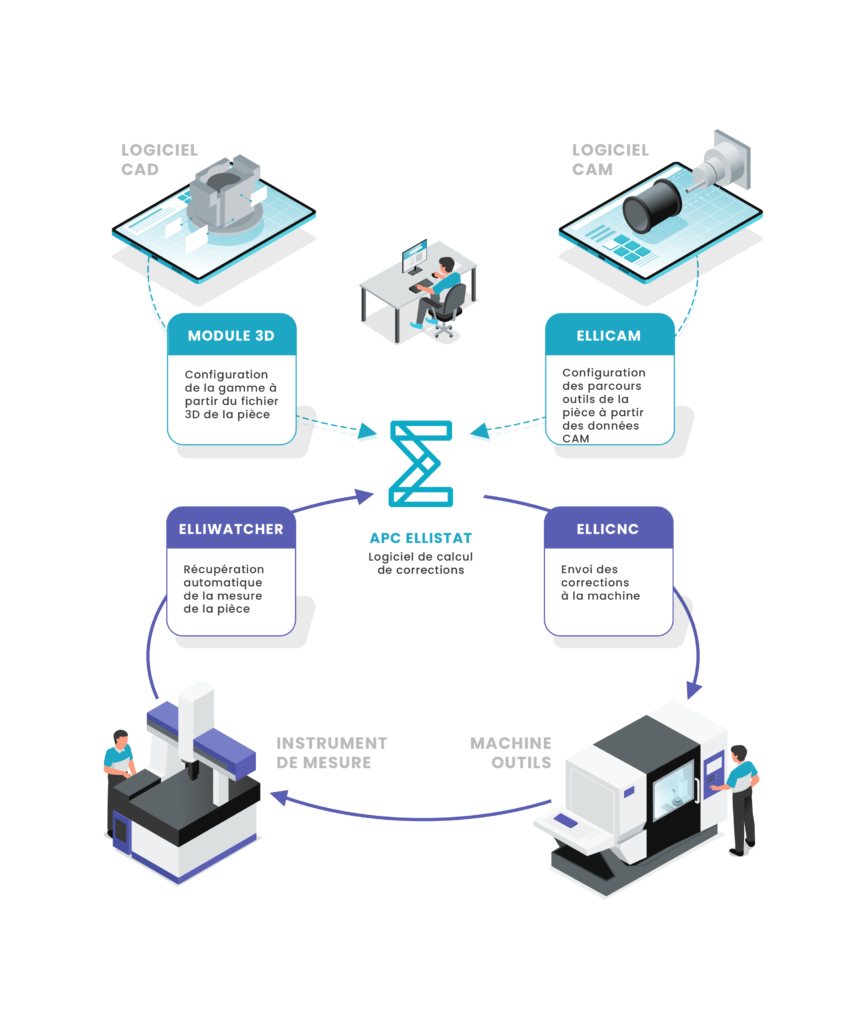
The part meets specifications right from the first machined piece. The scrap rate drops (documented customer case: from 4 % to 1.5 %), and process capabilities improve significantly (Ppk increased from less than 1 to approximately 1.4). The APC is compatible with the major CNC manufacturers on the market (Fanuc, Siemens, Mitsubishi, Mazak, Heidenhain, Okuma…), which gives it virtually universal connectivity. An operator can perform adjustments that they previously could not have managed on their own, reducing reliance on experienced adjusters and improving OEE. Today, it is the central technological component of the Ellistat suite and the feature that most sets it apart in the industrial quality software market.
3. Ellistat SPC (Statistical Process Control) — Monitor your processes on a daily basis
The module SPC (Statistical Process Control) was a natural progression from APC. Once the machines have been automatically tuned, it is still necessary to monitor the process’s stability over time. Ellistat’s SPC provides this real-time statistical monitoring, with comprehensive control charts, capability calculations (Cp, Cpk, Pp, Ppk) and early detection of deviations before they lead to nonconformities.
It integrates seamlessly into the production workflow and enables quality teams to manage variability rather than be at its mercy. Connected to other modules, it also feeds into Data Analysis for more in-depth investigations into the causes of deviations.
4. Ellistat IQC (Incoming Quality Control) — Reduce Your Quality Control Checks
The module IQC (Incoming Quality Control) covers supplier incoming inspection, with a unique feature not found in other solutions on the market: Characteristic-Based Energization. While most tools apply a uniform sampling plan to an entire lot, Ellistat's IQC adjusts the level of inspection on a characteristic-by-characteristic basis, depending on each supplier's quality history.
Result: The number of inspections is cut in half while maintaining the same level of quality. This translates into tangible time savings on the receiving lines. The module complies with ISO 2859 and ISO 3951 standards, making it easy to integrate into certified quality systems.
5. Ellistat E-Learning – Help Your Team Build Their Skills
The module E-learning It was created during the COVID-19 lockdown, when it became impossible to train teams in person. Rather than suspending training, Ellistat developed a comprehensive platform to continue fostering a culture of quality remotely.
The e-learning package covers the fundamentals of Lean and Six Sigma in the methodological tradition of Maurice Pillet, a leading French authority on these topics. Its real advantage: it enables quality to be promoted on a large scale throughout the company, including among employees who would never have had access to in-person training. Operators, technicians, team leaders—everyone can develop their skills at their own pace, from any workstation.
6. Ellistat METRO — Manage Your Fleet of Measuring Instruments
The module METRO manages the entire fleet of measuring instruments. It centralizes the maintenance records for each instrument, schedules calibrations, manages Gage R&R, and sends automatic alerts as deadlines approach.
Its key operational feature: the automatic blocking of non-compliant instruments. As soon as an instrument exceeds its calibration date or fails a verification test, it is automatically flagged as unavailable, ensuring that no production measurements are taken with an instrument that is out of service. For quality teams subject to regular audits, this provides peace of mind and ensures immediate compliance with documentation requirements.
7. Ellistat OEE — Monitor the OEE of Your Machines
The module TRS was introduced in 2026 as a logical extension of the APC and the existing machine connection with the CNC controls. Since Ellistat already communicates with the machines to send corrections, it was a natural step to use this channel to also report availability and production data.
The module thus allows you to calculate the Synthetic Return Rate directly from machine data, without manual entry, and to cross-reference these metrics with quality data from the suite. It provides a unified view of performance and quality on a single platform.
8. Ellistat ROUTINES — Track Your Field Routines
The module ROUTINES was also launched in 2026, with a different objective than the other modules: to structure and track on-the-shop-floor rituals. It allows you to define and manage Gemba Walks, shop floor rounds, audit checklists, or any other recurring quality or production ritual.
Every step is tracked, deviations are reported, and management has real-time visibility into the execution of routines. In an environment where adherence to procedures on the ground often depends on individual goodwill, the ROUTINES module provides structure and traceability that transform these informal habits into reliable and auditable processes.
Why is an integrated suite a game-changer compared to standalone tools?
The true value of an industrial quality software suite goes beyond the sum of its individual modules. What sets Ellistat apart is the flow of data between its components: a deviation detected by SPC can be investigated directly in Data Analysis; an incoming quality control (IQC) inspection updates the supplier history; and a corrective action sent by APC enriches the OEE tracking.
This continuity eliminates the need for manual re-entry, file exports sent via email, and—most importantly—the loss of information between two software systems that don’t communicate with each other. For a quality team that needs to respond quickly to an audit or trace the root cause of a nonconformity, this native integration often makes the difference between an investigation that takes just a few minutes and several days of searching through scattered files.
FAQ
What is an industrial-grade software suite?
It is a suite of software modules covering the various needs of the quality function in production—statistical control, machine tuning, acceptance testing, instrument management, and data analysis—integrated onto a single platform to enable data sharing among them.
Do all Ellistat modules need to be deployed at the same time?
No, the suite is modular: a company can start with a single module (usually SPC or APC) and gradually expand as needed and as its quality maturity grows.
What is the difference between the SPC and the APC?
SPC monitors the stability of a process over time and issues an alert in the event of a deviation. APC goes a step further: it automatically corrects the machine tool’s settings as soon as a deviation is detected, without waiting for human intervention.
Does the Data Analysis module require advanced training in statistics?
It is designed to be used by Six Sigma practitioners and process engineers, but its true value becomes apparent only when it is connected to production data from other modules, which simplifies analysis compared to general-purpose statistical software used on its own.
Is Ellistat suitable for industrial SMEs, or only for large corporations?
The user base ranges from industrial SMEs to major automotive, aerospace, and pharmaceutical companies, thanks in particular to the modular approach, which allows users to get started on a limited scale.