Which technology should you choose for your workshop?
L’APC (Automated Process Control) and the CLM (Closed-Loop Manufacturing) are now at the forefront of the precision turning industry. They are presented as the ultimate solutions for eliminating scrap and automating tool corrections. But what are the fundamental differences between the two? Should you opt for an «Automated Process Control» solution or a «Closed-Loop Manufacturing» approach? Let's decipher these two concepts to help you make sense of them.
What is APC?
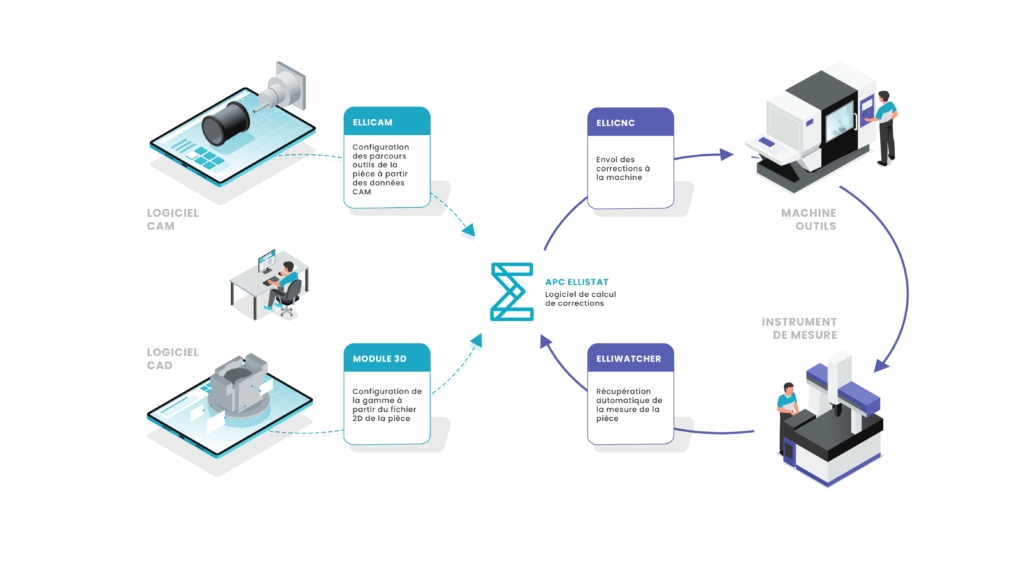
L’Automated Process Control (APC) is a software architecture for dynamic machine tool control. In concrete terms, the APC intervenes to reduce the gap between the part produced and its ideal model. The system is based on three pillars:
- Measurement: Data acquisition via a checking fixture (caliper, feeler, three-dimensional machine, etc.).
- Analysis: Statistical calculation of drift in relation to nominal dimension.
- Correction: Automatic transmission of tool correctors to the CNC.
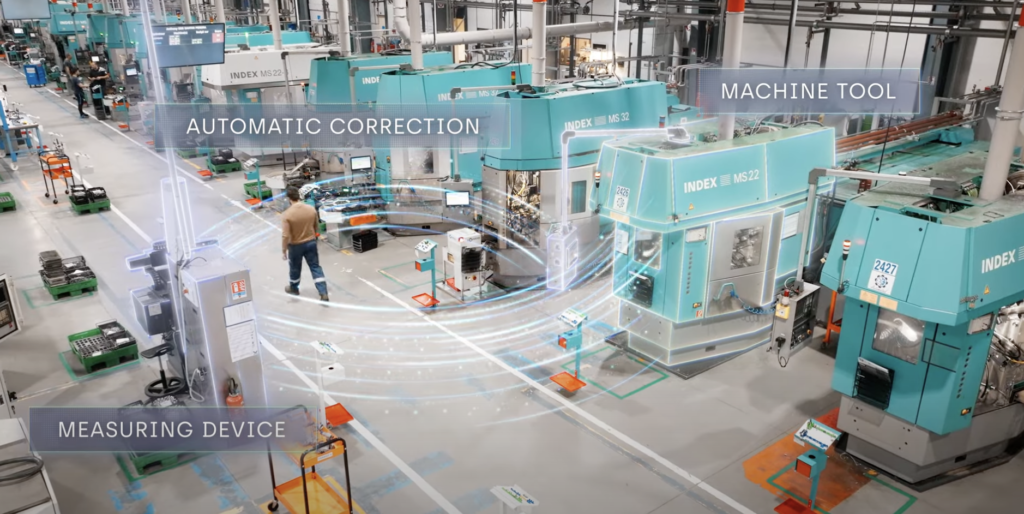
In a high-precision environment, the APC is a major asset for stabilizing production without the operator having to intervene in machine offsets.
What is Closed-Loop Manufacturing?
The Closed-Loop Manufacturing (CLM), CLM, or closed-loop manufacturing, is an integrated method for ensuring production efficiency and conformity in real time. Like APC, CLM relies on a continuous feedback loop to optimize performance:
- Measurement: Recovery of actual part dimensions after machining.
- Analysis: Automatic determination of the correction required (direction and amplitude).
- Correction: Immediate adjustment of machine parameters for the next part.
CLM is particularly prized for its ability to maintain dimensions strictly within tolerances, reducing dependence on manual know-how and minimizing production downtime.
Why set up such systems?
Whether it's called APC or Closed Loop Manufacturing, automated tool correction offers crucial advantages for a shop's competitiveness:
- Drastic reduction in scrap : The system reacts at the very first drift, even before the tolerance limits are exceeded.
- Workforce optimization : Operators no longer waste time entering correction values, and can concentrate on higher value-added tasks.
- Consistent quality : The «first piece» conforms more quickly, and thermal drift is automatically compensated for throughout the day.
How do you calculate performance gains?
The prerequisites for measuring the effectiveness of APC or Closed Loop Manufacturing are exactly the same. You'll need to compare your current scrap rate with that obtained after automation. The results are often unambiguous: companies using these technologies report up to 90 % of scrap reduction and a drop in 75 % manual operations on graders.
Key differences between APC and Closed-Loop Manufacturing
Since the question is asked, here is the answer: APC and Closed Loop Manufacturing are strictly identical.
These are simply two terminologies for one and the same concept: the slaving of a machine tool to a means of measurement. L’APC is a term coined by the Ellistat company to designate its machine-tool control module, while the term Closed-Loop Manufacturing is the standard term used in the machining world to describe this same feedback loop.
Switching from one to the other doesn't require any change of philosophy, just an adaptation of the commercial vocabulary 😉
Conclusion
Whether you choose to talk about «Automated Process Control» or «Closed-Loop Manufacturing», the objective remains the same: a smarter plant with less waste. It's not the acronym on the brochure that's important, but the ability of your equipment to self-correct to ensure profitability. To maximize your potential, it's time to close the loop!