


Waiting three years to confirm a three-year lifespan is rarely acceptable.
Accelerated testing subjects the product to a increased stress : temperature, voltage, load, humidity… and then extrapolate to normal conditions.
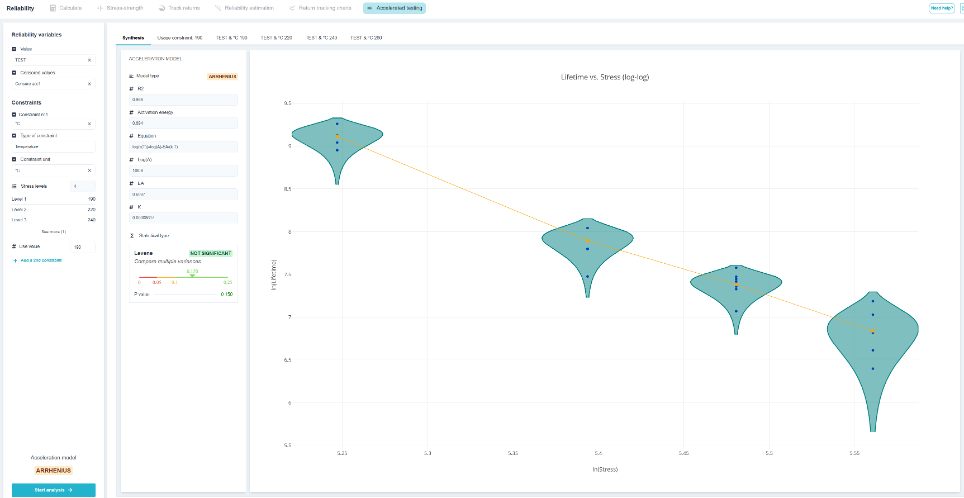
Acceleration Models Available:
| Model | Typical constraint |
| Arrhenius | Temperature: The Model of Chemical Degradation |
| Eyring | Temperature, with a second factor |
| Inverse-Power Law | Stress, mechanical load, pressure |
| Peck | Combined Temperature and Humidity |
| Coffin-Manson | Thermal cycling, fatigue |
| Basquin | Mechanical Fatigue Under Stress Amplitude |
Enter the model type, the one(s) constraint variables. There is a button that allows you to’Add a second constraint, the column of the failure values and the censorships. Arrhenius asks for a activation energy.
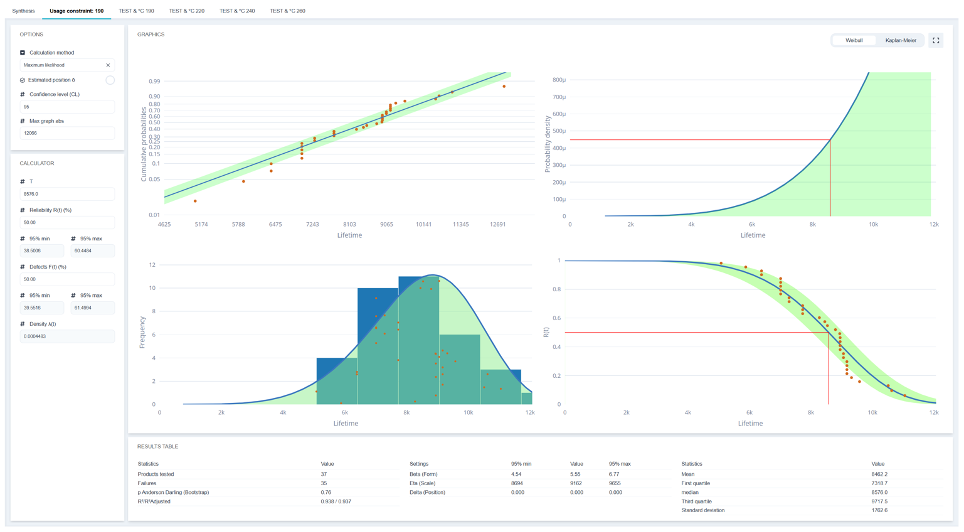
The results show the’equation of the fitted model, its R2, the graph Lifespan vs. Stress (log-log) and the acceleration factor.
💡 The log-log graph is used to check validity: the constraint levels should align. A point that deviates indicates that this level changed the failure mechanism Above a certain temperature, the degradation is no longer the same. This level must be excluded from the extrapolation.
⚠️ This is the main risk of the method: Accelerating too hard triggers another failure mode., and we then extrapolate a law that does not accurately describe the product’s actual behavior. Stay within a range where the mechanism remains the same, and be wary of very high acceleration factors.
💡 Plan ahead at least three levels of constraint. With two points, we draw a line through them: there is no way to verify that it is a straight line.