


This analysis aims to group individuals into families without having defined the families in advance.
Zone 1 : The method and its options.
⇒ K-means : For families of comparable size, you must specify their number; ;
⇒ Binary Division : cuts the cloud in half, one half at a time; ;
⇒ Gaussian mixtures : accommodates families with different shapes and dispersions; ;
⇒ DBSCAN : figures out the number of families on his own and knows when to skip some points. Set by Epsilon (the neighborhood radius) and Minimum points.
Number of clusters (K) Specifies the number of families for the first three methods. Initial value ensures that the result is reproducible from one calculation to the next.
Zone 2 : the cloud in the’Principal Component Space (PCS), in 2D or 3D, one color per group.
Zone 3 : For each variable, a test that answers the question: “Does this variable actually distinguish between the groups?”—a Fisher’s test and a Kruskal-Wallis test, with their conclusions color-coded from highly significant to not significant.
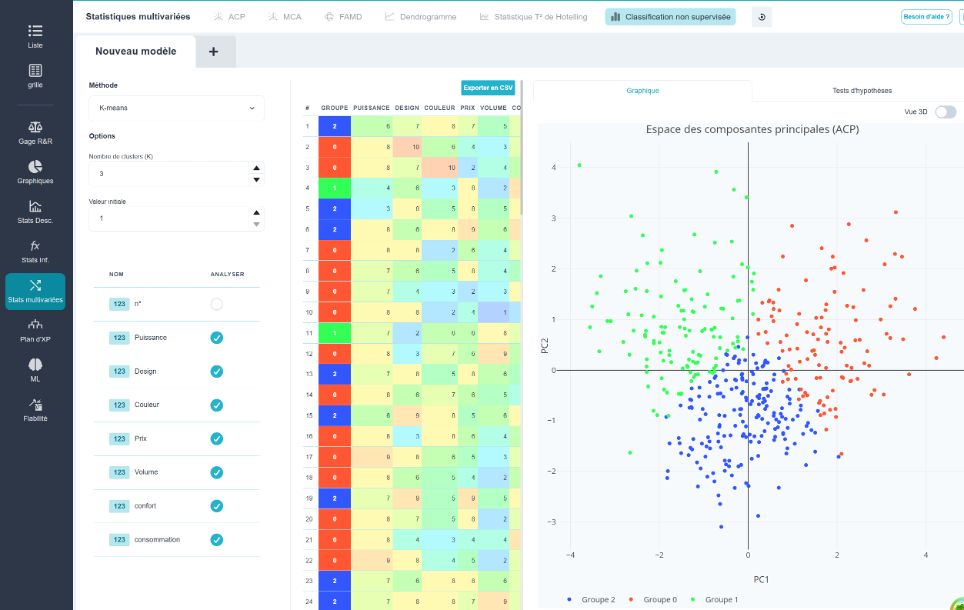
💡 Zone 3 validates the classification. Groups that appear clearly separated on the screen but for which no variables are significant have no business meaning: the partition exists in the graph, not in the data.
💡 The same classification is available directly in the ACP plot, under the «Unsupervised Classification (K-Means)» box. The number displayed next to each point is its family.