


This is the page for the full quadratic modeling : linear effects, interactions, and squares. This method alone makes it possible to locate an optimum within the domain and estimate its position.
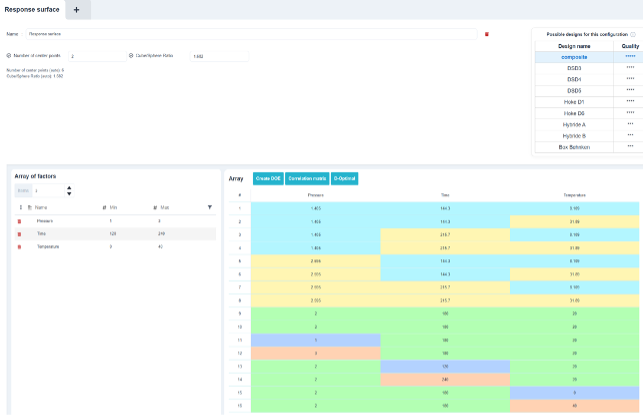
The factors must be quantitative, the page displays «Factors must be quantitative» if a value is not numeric, and their number is limited to 6. Beyond that, no tables are provided.
1. Available tables
| Table | What She Is | Quality |
| composite | Centered composite design: factorial, star-shaped, and central points. The standard. | ***** |
| Behnken Box | Edge centers of the domain. Avoid simultaneous extreme combinations. | *** |
| Hoke D1 / D4 / D6 | Economic designs with a small number of trials. | **** |
| Hybrid A / B | Very cost-effective plans for 3 and 4 factors. | *** |
| DSD3 … DSD8 | Definitive Screening Designs, used here in modeling. | **** |
The list depends on the number of factors: composite and Hoke designs with 2 factors; DSD, hybrid, and Box-Behnken designs with 3 and 4 factors; and Hoke and Box-Behnken designs with 5 and 6 factors.
💡 Box-Behnken rather than composite when extreme combinations are impossible or dangerous: maximum temperature and maximum pressure at the same time. Box-Behnken never visits two extremes simultaneously, whereas the composite method even goes beyond the boundaries of the cube (or hypercube) with its star-shaped points.
2. The two composite settings
The composite view, and only the composite view, displays two settings:
- Number of central points ;
- Cube-to-Sphere Ratio (α): the distance of the points in the star, in coded units. When α = 1, the star is placed on the faces of the cube; when α > 1, it is placed beyond the cube.
Ellistat calculates and displays the default values below the fields, recalculated each time the number of factors changes:
| Factors | Key Points | Cube-to-Sphere Ratio |
| 2 | 5 | 1,414 |
| 3 | 6 | 1,682 |
| 4 | 7 | 2 |
| 5 | 6 | 2 |
| 6 | 9 | 2,28 |
⚠️ These values provide a plan rotation-invariant : The prediction accuracy depends only on the distance from the center, not on the direction. It is acceptable to adjust these parameters—in particular, setting α to 1 when the star-shaped points would extend beyond the physically feasible domain—but doing so causes us to lose this property, and the accuracy becomes better in some directions than in others.