


These calculators answer the question in the contract: How many units, and how long, will it take to prove the claimed reliability?
Enter the reliability yet to be proven or the MTTF to be demonstratedthe confidence level, and the theoretical reliability law to be considered.
- Test Plan Design : demonstrate reliability; ;
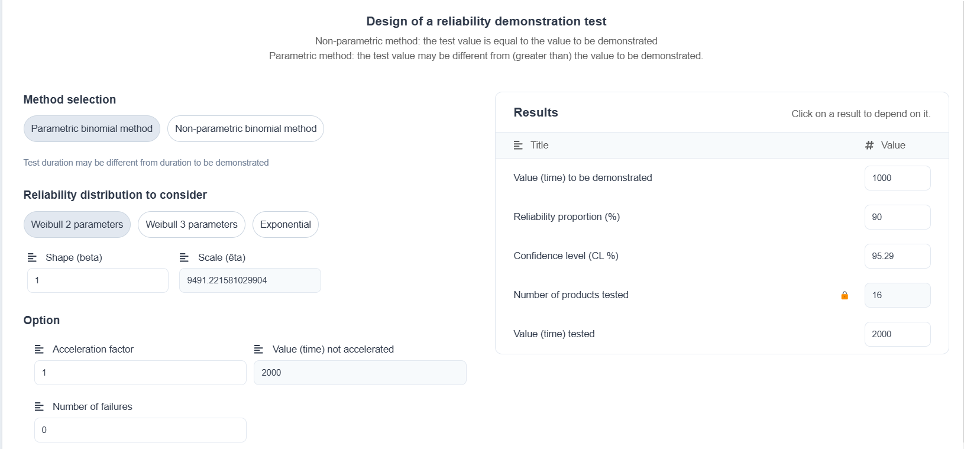
Allows you to calculate a result (where the padlock is placed) based on the other parameters. For example, to demonstrate 90% reliability at 1,000 cycles with a 95% confidence level, there must be 0 failures out of 16 products over 2,000 cycles.
- Chi2 Floor Plan Design : Demonstrate reliability by accumulating operating hours. Based on the chi-squared distribution, it determines the required cumulative test duration; ;
- MTTF Design : demonstrate an MTTF value; ;
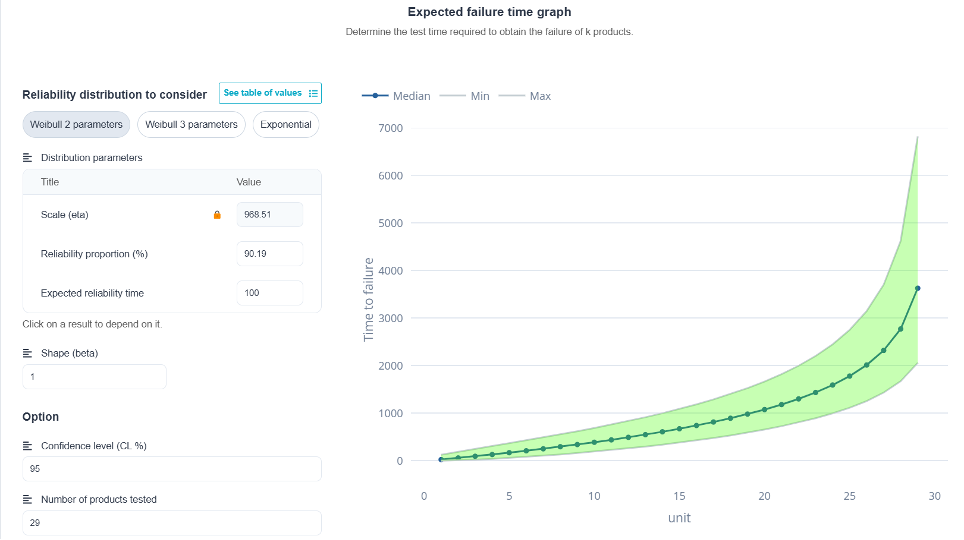
- Failure Time : the test time required for k products to fail. For example, if a product follows a Weibull distribution with beta = 1 and a reliability rate of 90% is expected at t = 100, Ellistat calculates the corresponding eta as 968 (the padlock icon indicates the result), and the curve shows the time required for failures to occur based on the number of products being tested (in this case, 29).
⚠️ The Chi2 Plan assumes an exponential distribution, that is, β = 1, meaning a constant failure rate. This is a strong assumption: if your product wears out (β > 1), the plan is optimistic. The application explicitly points this out. Use it only under a random failure model, or when you are aware of the bias.
💡 The usual lesson from these calculators is a harsh one: demonstrating high reliability with a high degree of confidence requires a lot in hours. This is a strong argument for negotiating either an accelerated trial period or a more realistic commitment, and the best time to do so is before signing the contract.