


When the inspection is a pass/fail determination—OK/KO, presence of a defect, appearance—there is no measurement to break down. In that case, we measure the concordance among auditors, and in relation to a standard prepared by an expert.
Each inspector evaluates each part multiple times. Data entry is done with a click: Click for OK, Ctrl+Click for KO.
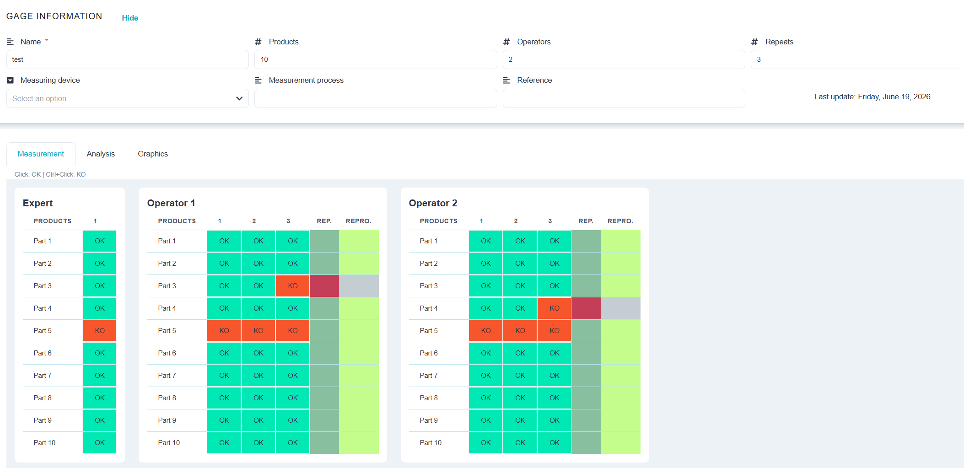
Indicators:
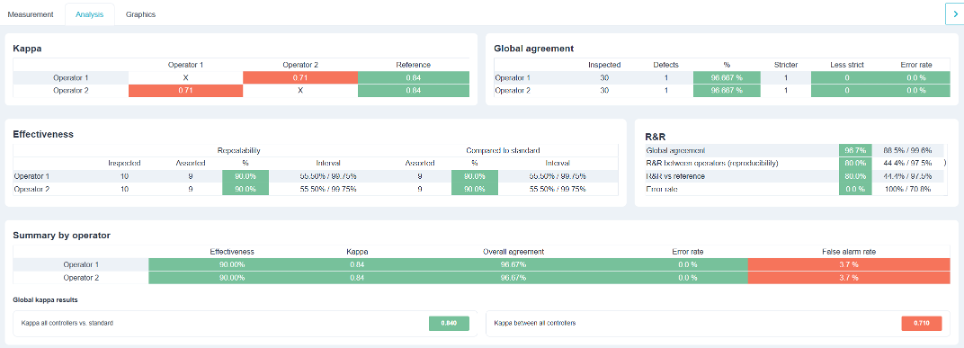
- Repeatability : Does a controller evaluate himself in the same way from one passage to the next?
- Comprehensive Agreement / overall consistency : Do all the controllers and the switchboard agree?
- Kappa : agreement corrected for chance. Two inspectors who report that everything is in order agree 100 % without actually checking anything; Kappa, on the other hand, does not make this mistake. The threshold used is 0,75.
- Kappa stands out among all controllers and Kappa vs. the Standard : The first indicates whether they are consistent with one another, and the second whether they are correct. Highly consistent but entirely incorrect evaluators yield an excellent Kappa among themselves and a poor Kappa against the standard.
- Effectiveness, error rate, false alarm rate : the proportion of correct judgments, missed defects, and correctly identified parts that were rejected, respectively.
- Stricter / Less strict : the direction of the bias for each inspector. An inspector who is consistently stricter causes unnecessary rejects; one who is more lenient allows defects to slip through.
- The Summary by Operator Items inspected, sorted, and percentage, by inspector.
💡 Distinguishing between these two types of errors is important from an economic standpoint: a false alarm costs a good part, while an error costs a customer. They do not have the same cost, and the control criteria must be set accordingly.